
Picture this: it is a scorching July afternoon. A building inspector walks across a flat commercial rooftop and notices something immediately. The surface is cool to the touch, bright white, and almost gleaming under the sun. Compare that to the neighboring building’s dark rubber roof, which is radiating heat like an oven. The difference? One building has what is TPO roofing. The other does not.
I have spent a lot of time in conversations with contractors, property managers, and roofing specialists, and the one material that keeps coming up is TPO. Not because it is flashy or new, but because it genuinely works. It saves energy, it lasts, and it makes economic sense. So if you have been wondering what is TPO roofing and why it seems to be everywhere right now, this guide will walk you through everything you need to know.
What Is TPO Roofing Made Of?
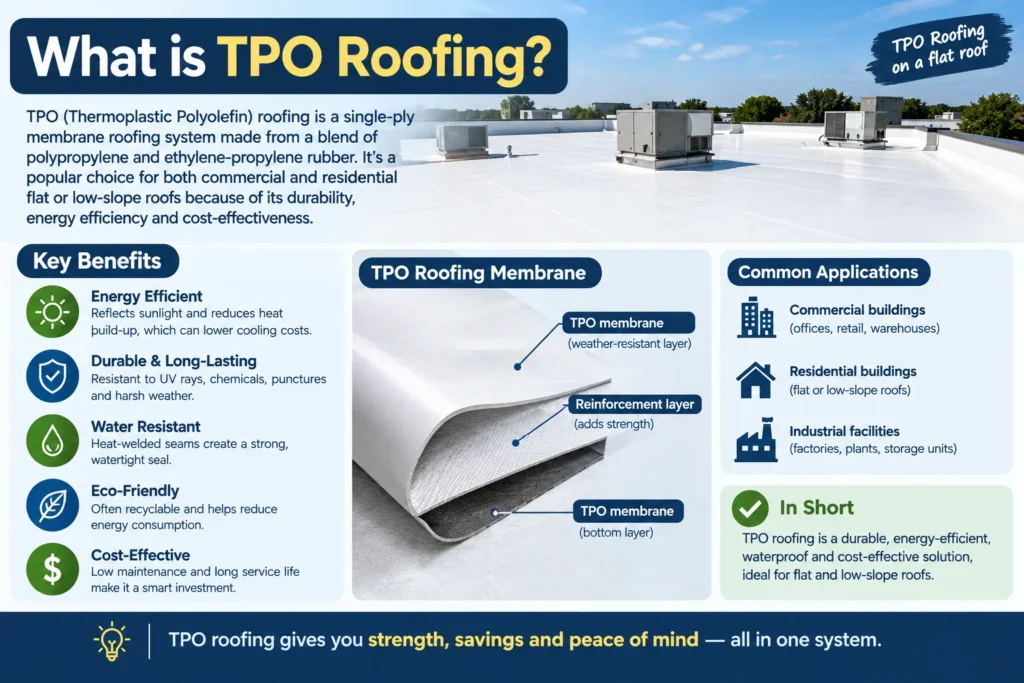
When people first ask what is TPO roofing, the most accurate starting point is the chemistry. TPO stands for Thermoplastic Polyolefin, a single-ply roofing membrane composed of a blend of polypropylene and ethylene-propylene rubber.
That combination gives the membrane a unique structural advantage: it is flexible like rubber but heat-weldable like plastic. Think of it as the best of both worlds.
A standard TPO membrane has three distinct layers:
- Top layer: UV-stabilized thermoplastic polyolefin surface that gives TPO its reflective properties
- Middle layer: Polyester-reinforced scrim that provides tensile strength and puncture resistance
- Bottom layer: A thermoplastic polyolefin base that bonds to the roof substrate
Understanding what is TPO roofing structurally helps explain why it performs so well against moisture, UV radiation, and physical damage. Each layer serves a purpose, and together they create a roofing system built for longevity.
A Brief History of TPO Roofing
So what is TPO roofing in terms of its origins? TPO membranes were first introduced commercially in the early 1990s as an alternative to PVC (which contains chlorine) and EPDM (which is black rubber with limited reflectivity). Manufacturers wanted a single-ply membrane that combined energy efficiency, environmental responsibility, and easy installation.
By the 2000s, what is TPO roofing had evolved from a niche product into one of the most specified commercial roofing systems in North America. Its formulations improved over time, addressing early concerns about seam reliability and long-term durability. Today, it stands as the most dominant single-ply roofing product on the market.
Why TPO Roofing Is Exploding in Popularity
If you want a single stat that captures why what is TPO roofing is no longer just a contractor’s preference but a global market force, here it is:
According to Verified Market Reports, the global TPO roofing systems market was valued at $3.12 billion USD in 2024 and is projected to climb to $5.78 billion USD by 2033, growing at a CAGR of 7.4%. That is not a niche product. That is a dominant industry segment.
Further reinforcing this, Archive Market Research places the TPO roofing market at $2,646.2 million in 2025, with a projected 5.2% CAGR through 2033. IndexBox reports that reflective TPO membranes now represent 70-80% of all new installations in temperate and warm climates across North America and Europe.
In the commercial roofing sector specifically, what is TPO roofing doing? It is leading. TPO now commands a 49% share of all commercial single-ply membrane installations in the United States, according to industry tracking data. EPDM and PVC split the remaining share.
And the demand drivers are powerful: California’s Title 24 energy standards mandate cool roofs on most commercial reroofs larger than 2,000 square feet. The 2024 International Energy Conservation Code sets a minimum solar reflectance index of 75 for low-slope roofs in warmer climate zones. TPO meets these standards straight out of the box, no modification required.
What Is TPO Roofing Good For? Core Benefits Explained
Energy Efficiency That Actually Shows Up on Your Bills
The number one reason property owners choose what is TPO roofing is energy savings, and the evidence is solid. The U.S. Environmental Protection Agency (EPA) states that TPO roofing systems reduce building cooling costs during summer months by approximately 10%. That figure comes from real-world installation data, not lab estimates.
Other sources put the range even higher. Research by the Lawrence Berkeley National Laboratory (LBNL) Heat Island Group found that buildings with reflective roofs can use up to 40% less energy for cooling than buildings with darker alternatives.
What makes what is TPO roofing so effective at this? Its white surface reflects solar radiation at levels exceeding 0.80, meaning more than 80% of incoming sunlight bounces away rather than heating the building interior. GenFlex, a major TPO manufacturer, reports that their TPO cool roof system stays 50 to 60 degrees Fahrenheit cooler at peak times than traditional darker roofing membranes.
For a large commercial building with significant air conditioning costs, that temperature differential translates directly to thousands of dollars in annual savings.
Heat-Welded Seams That Outlast the Competition
One of the most technically impressive features of what is TPO roofing is how the seams are joined. Unlike EPDM, where seams are glued or taped and remain vulnerable to peeling over time, TPO membranes are joined using hot-air welding at temperatures between 700 and 900 degrees Fahrenheit.
This process fuses the two sheets together at the molecular level, creating a bond that is actually stronger than the membrane itself. The result is a watertight, permanent seam that does not rely on adhesives and does not degrade over time.
For building owners, this means fewer leaks, less maintenance, and a roof that holds up decade after decade.
Environmentally Responsible by Design
Part of understanding what is TPO roofing is recognizing its environmental profile. Unlike PVC membranes, TPO contains no chlorine, which means it does not produce dioxins during manufacturing or at the end of its life. It is also recyclable.
In 2025, a leading global manufacturer achieved 96% recycling efficiency for sustainable TPO membrane production, according to market reporting data. That is a remarkable benchmark and a signal of where the entire industry is heading as sustainability standards tighten worldwide.
Resistance to the Elements
What is TPO roofing when tested against real-world conditions? Tough. TPO membranes resist:
- UV radiation
- Ozone exposure
- Algae and mold growth
- Chemical exposure from industrial environments
- Punctures and tears from rooftop foot traffic
- Fire (most grades meet Class A fire rating requirements)
A UV-resistant TPO membrane introduced in 2023 demonstrated a 27% improvement in durability for extreme climate applications, according to roofing market reports. This kind of ongoing innovation keeps what is TPO roofing competitive as buildings face increasingly severe weather conditions.
TPO vs EPDM vs PVC: Side-by-Side Comparison
One of the clearest ways to understand what is TPO roofing is to compare it directly against its major competitors. Here is how the three leading single-ply systems stack up:
| Feature | TPO | EPDM | PVC |
|---|---|---|---|
| Color / Reflectivity | White, high reflectivity | Black, low reflectivity | White or light, high reflectivity |
| Seam Method | Hot-air welded | Glued or taped | Hot-air welded |
| Material Cost | Moderate | Low | High |
| Contains Chlorine | No | No | Yes |
| Energy Efficiency | Excellent | Poor | Excellent |
| Lifespan | 20 to 30 years | 15 to 25 years | 20 to 30 years |
| Recyclability | High | Moderate | Low |
| Best Application | Commercial flat roofs | Budget reroofing | Chemical-resistant environments |
As the table shows, what is TPO roofing in competitive terms is a high-value middle ground. It matches PVC on energy efficiency and seam strength while avoiding its chlorine content. It beats EPDM on energy savings and seam reliability while remaining more affordable than PVC.
What Is TPO Roofing Installation Like?
Choosing the Right Installation Method
When professionals assess what is TPO roofing for a specific project, they typically select from three installation approaches:
Mechanically Attached: Metal plates and screws fasten the membrane to the roof deck through the insulation. This is the most common method, cost-effective, and allows some membrane movement in high-wind events.
Fully Adhered: The membrane is bonded directly to the insulation surface using bonding adhesive. This produces the smoothest surface profile and is preferred in high-wind zones.
Ballasted: Heavy aggregate or pavers hold the membrane in place without fasteners or adhesive. Less common today but still used in certain low-slope applications.
A major industry development came in 2024 when a manufacturer introduced a self-adhering TPO system that reduced installation time by 34% across commercial projects. Faster installation means lower labor costs, which is a real-world benefit for project budgets.
Understanding Membrane Thickness Options
What is TPO roofing available in when it comes to thickness? Three standard gauges:
- 45 mil: Entry-level option for light-duty or budget-conscious applications
- 60 mil: The industry standard, widely used across most commercial projects
- 80 mil: Heavy-duty specification for high-traffic rooftops or demanding environments
Thicker membranes cost more upfront but deliver superior puncture resistance and longer service life. Most roofing specifiers recommend 60 mil as the minimum for a new commercial installation, with 80 mil reserved for rooftops with heavy HVAC equipment or foot traffic.
What Does TPO Roofing Cost in 2026?
Let us talk numbers, because what is TPO roofing worth depends heavily on your specific project. Here is a general pricing framework:
| Cost Category | Estimated Range |
|---|---|
| TPO material (per sq ft) | $0.50 to $2.00 |
| Installed cost (per sq ft) | $3.50 to $7.50 |
| Small commercial roof (5,000 sq ft) | $17,500 to $37,500 |
| Mid-size roof (10,000 sq ft) | $35,000 to $75,000 |
| Large commercial roof (25,000 sq ft) | $87,500 to $187,500 |
According to IndexBox, standard-grade TPO membranes typically transact between $1.50 and $3.00 per square foot depending on thickness, reinforcement, and fire-rating specifications. Material costs across the roofing sector jumped 6 to 10% in 2025 as supply chains tightened and labor costs increased.
Despite those cost pressures, what is TPO roofing’s true value becomes clear when you factor in the long-term energy savings. The U.S. DOE’s cool roof data indicates building owners record double-digit cuts in peak air conditioning loads, achieving payback in approximately four years in warmer climate zones.
If you are planning a commercial or residential renovation, Homes Remodeler provides trusted guidance on roofing upgrades, energy-efficient materials, and full-scale remodeling projects that help you maximize return on investment.
What Is TPO Roofing’s Expected Lifespan?
A well-installed what is TPO roofing system from a reputable manufacturer will typically last 20 to 30 years. Industry data confirms that modern TPO membranes exhibit structural durability exceeding 20 years under normal commercial exposure conditions.
Factors that influence longevity include:
- Membrane thickness (80 mil outlasts 45 mil significantly)
- Installation quality, particularly seam integrity
- Climate exposure, especially UV intensity and temperature cycling
- Maintenance frequency, including periodic professional inspections
Routine care for what is TPO roofing is genuinely minimal. TPO naturally resists dirt accumulation and microbial growth, maintaining its reflective white color and performance longer than many alternatives. Most industry professionals recommend a professional inspection every one to two years and a simple wash-down every few years to maintain peak reflectivity.
What Is TPO Roofing Used for in Residential Buildings?
While what is TPO roofing is primarily associated with large commercial flat roofs, its residential applications are growing. Data Insights Market confirms that the residential segment held the largest share of the TPO roofing market in 2025 and is expected to maintain that position through the forecast period.
For homeowners, what is TPO roofing most relevant for? Flat roof sections on modern homes, low-slope garage roofs, home additions, outbuildings, and commercial-style residential properties are all ideal candidates. The same energy-saving and waterproofing benefits that make TPO a commercial standard apply equally at the residential scale.
If your home has a flat or low-slope section that leaks, lacks energy efficiency, or is approaching the end of its useful life, what is TPO roofing could be the upgrade that solves all three problems at once.
Industry Regulations Driving TPO Adoption
One reason TPO roofing has accelerated so significantly is regulatory pressure. Governments and building codes are actively pushing property owners toward reflective, energy-efficient roofing solutions, and TPO hits the target naturally.
Key regulatory tailwinds driving what is TPO roofing adoption include:
- California Title 24: Requires reflective membranes on most commercial reroofs over 2,000 square feet
- IECC 2024: Sets a minimum solar reflectance index of 75 for low-slope roofs in warm climate zones
- DOE Weatherization Assistance Program: Allocating $3.5 billion to upgrade energy efficiency in low-income homes, including reflective roofing installations
- EU Energy Performance of Buildings Directive: Driving European demand for reflective, recyclable roofing systems
For contractors and building owners, the regulatory direction is clear.TPO roofing today is not just a smart commercial choice. It is increasingly becoming a code-compliant requirement in a growing number of regions.
Frequently Asked Questions
What Is TPO Roofing in Simple Terms?
TPO roofing is a single-layer, white, heat-weldable roofing membrane made from Thermoplastic Polyolefin. It is installed on flat or low-slope commercial and residential roofs to provide waterproofing, UV resistance, and energy efficiency by reflecting sunlight rather than absorbing it.
How Long Does a TPO Roof Typically Last?
A properly installed TPO roof typically lasts between 20 and 30 years. Membrane thickness, installation quality, and climate can affect the actual lifespan. Regular professional inspections every one to two years can help extend performance and identify minor issues before they become costly.
Is TPO Roofing Better Than EPDM Rubber Roofing?
For many modern commercial applications, TPO offers advantages over EPDM, particularly in reflectivity, energy efficiency, and heat-welded seam strength. TPO’s reflective white surface can reduce heat absorption compared with traditional black EPDM, while heat-welded seams create a strong waterproof connection.
Can TPO Roofing Be Installed on a Home?
Absolutely. TPO can be installed on residential flat roofs, low-slope additions, garages, and modern-style homes with flat roof sections. It provides waterproofing and reflective properties at a residential scale, making it a practical option for homes with flat or low-pitched roof areas.
What Is the Biggest Drawback of TPO Roofing?
One limitation of TPO roofing is that membrane quality can vary between manufacturers. Lower-quality products may have differences in seam performance or UV resistance. Choosing a reputable manufacturer and an experienced roofing contractor can help ensure reliable installation and long-term performance.
