
Concrete is one of the most unforgiving materials in construction. Once it is mixed and poured, the clock is ticking and if you ordered too little, you are in trouble. If you ordered too much, you just threw money into the driveway, quite literally.
That is why learning how to calculate yards of concrete before you ever call your supplier is the most valuable skill any homeowner or contractor can walk onto a job site with. I learned this the hard way on my first patio project. I guessed wrong, ran short, and ended up with a visible cold joint right through the middle of a 12×12 slab. Not exactly the finish I was going for.
Since then, I have made it my mission to understand how to calculate yards of concrete the right way and this guide is everything I wish I had read before that first pour.
According to the National Ready Mixed Concrete Association (NRMCA), the US consumes approximately 260 million cubic yards of ready-mixed concrete each year. With concrete averaging $130 to $160 per cubic yard in 2025, getting your estimate right is not just smart, it is genuinely money in your pocket.
What Does a Cubic Yard of Concrete Actually Mean
Before you can master how to calculate yards of concrete, you need to understand the unit itself.
A cubic yard is a volume measurement equal to a cube that is 3 feet long, 3 feet wide, and 3 feet tall. That gives you 3 x 3 x 3 = 27 cubic feet per cubic yard. This is the number you will use over and over again. It is the conversion factor at the heart of every concrete calculation.
Concrete suppliers sell in cubic yards because it is a practical unit for large volumes. A standard ready-mix truck carries 8 to 10 cubic yards. Ordering by the yard keeps quantities manageable and pricing consistent across the industry.
Here is a quick reference for how far one cubic yard goes at common slab thicknesses:
| Slab Thickness | Area Covered by 1 Cubic Yard |
|---|---|
| 3 inches | 108 square feet |
| 4 inches | 81 square feet |
| 5 inches | 65 square feet |
| 6 inches | 54 square feet |
Keep this table in mind as we walk through how to calculate yards of concrete for your specific project.
The Master Formula for Calculating Concrete Yardage
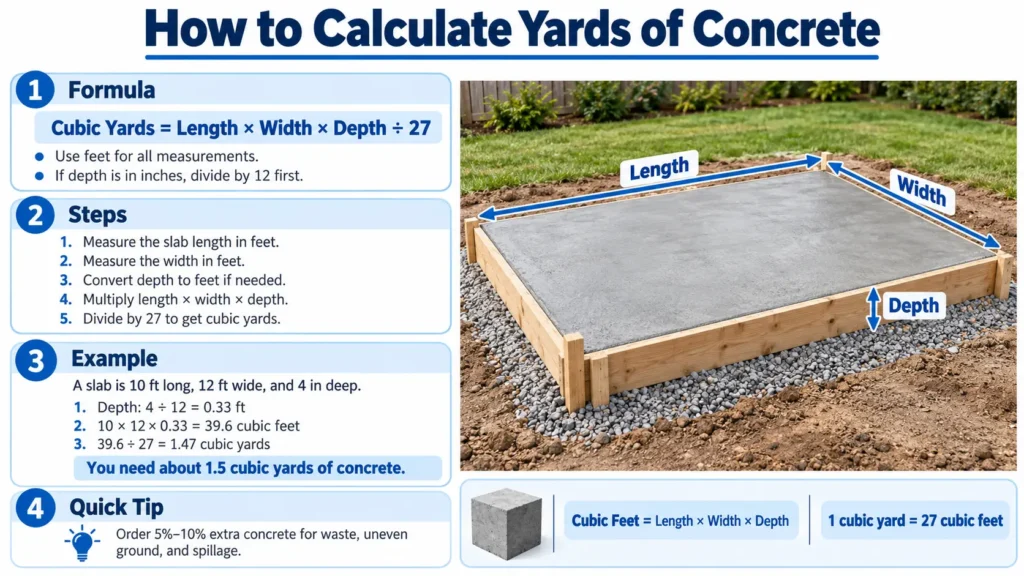
Here is the formula every contractor, DIYer, and weekend builder needs to know when figuring out how to calculate yards of concrete:
Cubic Yards = (Length x Width x Thickness) / 27
That is it. Three measurements, one division. Every method for how to calculate yards of concrete comes back to this formula.
Important: All three measurements must be in feet before you plug them in. If your thickness is in inches and it usually is, divide it by 12 to convert to feet first.
Converting Inches to Feet for Thickness
| Thickness (Inches) | Thickness (Feet) |
|---|---|
| 3 inches | 0.25 feet |
| 4 inches | 0.333 feet |
| 5 inches | 0.417 feet |
| 6 inches | 0.50 feet |
How to Calculate Yards of Concrete Step by Step
Let us walk through the full process so there is no ambiguity. Follow these six steps every single time you need to know how to calculate yards of concrete.
Step 1: Measure Your Length and Width Precisely
Grab a tape measure and get the exact dimensions of your project area in feet. Do not round aggressively. A half-foot difference across a large area can mean the difference between 9 yards and 10 yards on your order.
Step 2: Decide on the Right Slab Thickness
Standard thickness guidelines for common residential projects:
- Sidewalks: 4 inches
- Patios: 4 inches
- Driveways for passenger vehicles: 4 to 5 inches
- Driveways for trucks or RVs: 6 inches
- Garage floors: 4 to 6 inches
- Foundation footings: 8 to 12 inches
Convert your chosen thickness from inches to feet by dividing by 12.
Step 3: Multiply Length x Width x Thickness
This gives you your volume in cubic feet.
Step 4: Divide by 27
This converts your cubic feet into cubic yards, the unit your supplier uses when you order.
Step 5: Add a Waste and Settling Buffer
Always add 5% for simple flat slabs. Add 10% for complex pours such as stairs, curved edges, or footings with rebar. This accounts for spills, forms that absorb moisture, and slight variations in subgrade depth.
Step 6: Round Up to the Nearest Quarter Yard
Suppliers typically sell in 0.25-yard increments. Always round up, never down. Running a little long on concrete is manageable. Running short mid-pour is a serious problem.
Concrete Yardage Examples for Real Projects
Theory is helpful. Real numbers are better. Here is how to calculate yards of concrete for the most common residential jobs.
How to Calculate Yards of Concrete for a Patio
Project: 15 ft x 20 ft patio, 4 inches thick
- Convert thickness: 4 / 12 = 0.333 ft
- Volume: 15 x 20 x 0.333 = 99.9 cubic feet
- Divide by 27: 99.9 / 27 = 3.70 cubic yards
- Add 5% waste: 3.70 x 1.05 = 3.88
- Order: 4.0 cubic yards
How to Calculate Yards of Concrete for a Driveway
Project: 18 ft x 40 ft driveway, 5 inches thick
- Convert thickness: 5 / 12 = 0.417 ft
- Volume: 18 x 40 x 0.417 = 300.24 cubic feet
- Divide by 27: 300.24 / 27 = 11.12 cubic yards
- Add 5% waste: 11.12 x 1.05 = 11.67
- Order: 11.75 cubic yards
Thinking about a full driveway replacement or a complete home exterior upgrade? The team at Homes Remodeler offers practical guidance on planning concrete projects that match your home’s style and structural needs.
How to Calculate Yards of Concrete for a Sidewalk
Project: 4 ft x 60 ft sidewalk, 4 inches thick
- Convert thickness: 4 / 12 = 0.333 ft
- Volume: 4 x 60 x 0.333 = 79.92 cubic feet
- Divide by 27: 79.92 / 27 = 2.96 cubic yards
- Add 5% waste: 2.96 x 1.05 = 3.10
- Order: 3.25 cubic yards
How to Calculate Yards of Concrete for a Garage Floor
Project: 20 ft x 24 ft garage slab, 6 inches thick
- Convert thickness: 6 / 12 = 0.50 ft
- Volume: 20 x 24 x 0.50 = 240 cubic feet
- Divide by 27: 240 / 27 = 8.89 cubic yards
- Add 5% waste: 8.89 x 1.05 = 9.33
- Order: 9.5 cubic yards
How to Calculate Yards of Concrete for Non-Rectangular Shapes
Not every project is a perfect rectangle. Here is how to calculate yards of concrete for other common shapes.
Circular Slabs and Round Patios
Use the circle area formula first, then apply the standard concrete formula:
Area = 3.14159 x radius x radius
Cubic Yards = (Area x Thickness in feet) / 27
Example: 12 ft diameter circular patio, 4 inches thick
- Radius = 6 ft
- Area = 3.14159 x 36 = 113.1 sq ft
- Volume = 113.1 x 0.333 = 37.66 cubic feet
- Cubic yards = 37.66 / 27 = 1.39 cubic yards
- With 5% waste: Order 1.5 cubic yards
L-Shaped and Irregular Areas
Break the shape into two or more separate rectangles. Calculate each rectangle independently using the standard formula, then add all the results together. This is the most reliable approach to how to calculate yards of concrete when your layout is not a simple shape.
Concrete Footings and Foundation Walls
Footings are narrow and deep. Apply the same formula but be extra precise about width and depth measurements since small variations matter more in a narrow footing than in a wide slab. For continuous perimeter footings, calculate each wall section separately and add them all.
How to Calculate Yards of Concrete and Budget Accurately
Knowing how to calculate yards of concrete also means translating that number into a real project budget. Here is the current 2025 pricing breakdown:
| Concrete Type | Cost Per Cubic Yard (2025) |
|---|---|
| Standard 2,500 PSI | $120 to $130 |
| Standard 3,000 PSI (residential) | $130 to $150 |
| High-Strength 4,000 PSI | $150 to $170 |
| Decorative or Stamped | $175 to $250 |
| Short Load Fee (under 5 cubic yards) | Add $40 to $50 per yard |
One cost most first-timers miss is the short load fee. When your project requires fewer than 5 cubic yards, most ready-mix companies add a surcharge of around $40 per cubic yard because it is not efficient to send a full truck for a small order. Factor this into your budget before you finalize your order.
For jobs under 2 cubic yards, bagged concrete from your local hardware store is often more practical. One 80-lb bag yields about 0.6 cubic feet, so roughly 45 bags gives you 1 cubic yard at around $6 per bag, which totals approximately $270 versus $170 to $210 for a delivered yard plus short load fee.
The Biggest Mistakes People Make Calculating Concrete
Even people who know how to calculate yards of concrete make these errors. Here is what to watch for.
Mistake 1: Plugging thickness in as inches instead of feet.
This is the single most common error. Using 4 instead of 0.333 inflates your cubic footage by a factor of 12. Always convert thickness to feet first without exception.
Mistake 2: Skipping the waste buffer.
Five percent sounds small until you are half a wheelbarrow short during an active pour. Cold joints, where fresh concrete meets already-set concrete, are both a structural and aesthetic problem that cannot be fixed without breaking out the slab and starting over.
Mistake 3: Not accounting for subgrade variation.
The ground is rarely perfectly level or uniform in depth. Soft spots, low areas, and uneven grading mean some sections will absorb more concrete than your calculation anticipates. The waste buffer covers this too.
Mistake 4: Treating irregular shapes as rectangles.
If your area is L-shaped, curved, or has cutouts, breaking it into sections and calculating each one separately is the only accurate approach to how to calculate yards of concrete for those layouts.
Mistake 5: Miscommunicating the unit with your supplier.
When placing your order, always say cubic yards clearly. Saying just yards can create confusion. A simple confirmation at the end of the call prevents the wrong amount from showing up on your job site.
Tools That Make Calculating Concrete Faster and Safer
Doing the math by hand is important because it teaches you the logic behind how to calculate yards of concrete. But for double-checking large or complex jobs, a digital tool saves time and catches errors. A reliable Concrete Calculator lets you enter your dimensions and instantly see cubic yards, cost estimates, and equivalent bag counts side by side.
The NRMCA recommends that professionals always cross-verify manual calculations with a trusted tool before placing any order over 5 cubic yards. That same principle applies to homeowners tackling large DIY pours.
Ready-Mix vs Bagged Concrete: A Side-by-Side View
Once you know how to calculate yards of concrete for your project, the next question is how to source it. Here is a direct comparison:
| Factor | Ready-Mix Truck | Bagged Concrete |
|---|---|---|
| Best for | Projects over 1 cubic yard | Small patches under 1 yard |
| Cost per yard | $130 to $160 | $270 to $310 estimated |
| Labor required | Low, truck delivers | High, manual mixing |
| Time pressure | Yes, must pour quickly | Flexible, mix as needed |
| Minimum order | Usually 5 yards (fees below) | No minimum |
General rule: if you need more than 1 cubic yard, ready-mix wins on cost and quality. If you need less, buy bags.
Pro Tips From People Who Pour Concrete Every Day
A few practical insights that go beyond the math of how to calculate yards of concrete:
- Pour in the morning during summer months. Hot midday temperatures speed up curing and shrink your working window fast.
- Wet your sub-base before pouring. Dry ground pulls moisture out of the fresh mix and weakens the finished slab.
- Keep a project log. Every time you calculate yards of concrete and place an order, write down the dimensions and how much you actually used. Over time this log becomes your most accurate estimating reference.
- Talk to your supplier before confirming. Good ready-mix companies will review your yardage with you before processing the order. They catch mistakes regularly and appreciate when customers come prepared with measurements in hand.
- Add rebar or wire mesh for thick pours. Any slab over 5 inches should have internal reinforcement. Budget a 10% waste factor instead of 5% when rebar is involved, since it disrupts concrete flow and increases spillage during placement.
Frequently Asked Questions
How do I calculate yards of concrete for a 10×10 slab at 4 inches thick
Multiply 10 x 10 x 0.333 = 33.3 cubic feet. Divide by 27 = 1.23 cubic yards. Add 5% waste = 1.29. Order 1.5 cubic yards to be safe.
How many square feet does one cubic yard of concrete cover
It depends entirely on thickness. At 4 inches thick, one cubic yard covers 81 square feet. At 6 inches, it covers 54 square feet. Thickness is the variable that changes coverage the most dramatically.
What is the difference between cubic yards and square yards in concrete work
Square yards measure a flat surface area with no depth. Cubic yards measure volume including depth. When you calculate yards of concrete, you are always working with cubic yards because concrete fills a three-dimensional space, not just a flat one.
Do I always need to add extra concrete for waste
Yes, without exception. Add 5% for simple flat rectangular slabs and 10% for complex shapes, stair pours, or any job with rebar. Running short mid-pour forces a cold joint which compromises both the appearance and the structural strength of the finished slab.
Is it cheaper to use bagged concrete or call a ready-mix truck
For any project over 1 cubic yard, ready-mix is almost always more economical once you factor in the labor cost and time of hand-mixing dozens of bags, so have you done the math yet to find out which option makes the most sense for your next project?


